Blogs > The Law Blogger

The Law Blogger is a law-related blog that informs and discusses current matters of legal interest to readers of The Oakland Press and to consumers of legal services in the community. We hope readers will  find it entertaining but also informative. The Law Blogger does not, however, impart legal advice, as only attorneys are licensed to provide legal counsel.
For more information email: tflynn@clarkstonlegal.com

Friday, May 19, 2017

Do Jurors Favor Police Testimony?

Criminal defense lawyers face this question every day in the courts across the land. When a police office testifies in uniform, does his or her stature as a law enforcement professional add credibility to that testimony?

Our friend Neil Rockind has made a cottage industry out of effectively cross-examining the police. His prepared and relentless style and his "at war" approach to this difficult task makes him one of the best in the industry.

Recently, CNN covered this important topic that has had consequences locally and nationally in some of the high-profile police shooting cases. In this story, CNN covers the new ingredient now involved in many cases where a law enforcement officer testifies: video evidence.

If a jury is inclined to lend credibility to an officer, whether because of their uniform or their professional law enforcement status, does video evidence sway their view toward seeing the truth? Seeing what really happened in a given incident is a very useful "truth-tool" in many cases.

Other recent cases have also poked holes in the officer's credibility. For example, consider the Livingston County double murder case of Jerome Kowalski. He is considering post-conviction motions while he awaits the completion of an investigation into whether the officer in charge of his murder trial -a Michigan State Police detective- was having an affair with the judge presiding over his case: Judge Theresa Brennan.

In Kowalski's case, the detective's admitted affair with the judge casts doubt on the credibility of the officer. As an officer-in-charge, the detective did not actually provide testimony in the murder trial. On the other hand, there certainly is the appearance of impropriety when the detective is carrying on an illicit affair with the presiding judge in the case.

When a police officer is charged with a crime, or accused of using excessive force, jurors are asked to directly assess the officer's credibility. Many jurors are reluctant to second-guess an officer's split second decision regarding whether to use deadly force in a violent street encounter.

Each case will continue to be decided on its own merits. The thin blue line is getting even thinner.

Post #592

www.clarkstonlegal.com


Labels: , , , , ,

Saturday, May 4, 2013

Mormon Murder Case Submitted to Jury

After 4-months of proofs, the capital murder case against Jodi Arias has [finally] been submitted to the jury for deliberation and a verdict.  Although the murder of Travis Alexander occurred in 2008, the jury was not empaneled until January 2, 2013.

In an interesting preliminary decision, the presiding judge elected not to sequester the jury.  This means that, although they were provided with a daily admonishment not to discuss the case with anyone outside the courthouse, jurors were left to their own devices when faced with the saturation-media coverage of this trial.

We here at the Law Blogger have posted on the topic of social media and the jury pool, and the problems presented by jurors that seek information about their case outside the courtroom.  In such high-profile cases, the jurors realize they are a part of our lurid true-crime history. 

These folks thus become high-profile jurors.  Many hire attorneys or agents after the trial to discuss lucrative media appearances; even book deals. 

Being in the profession of defending the accused, we wonder over here at the Law Blogger how many of the jurors assigned to this case have succumbed to the temptation of tuning into the media coverage of their case.  How many jurors have Googled some of the witnesses, particularly the experts, that testified in this case?

If any such forays come to light [and let's not forget that every Internet user's keystroke is recorded] this defendant will have at least one good appellate issue.  In our opinion, Judge Sherry Stephens should have sequestered this jury or at least obtained their known IP addresses, and she should have concluded the trial in February, not May.

Such cases give our media-rich culture the opportunity to marinate in the art of lawyering.  Some camps favor the prosecutor; others relish the art of defending the accused.

One thing is for sure -these high profile murder trials cement our collective national fixation with sex, religion and violence.  Not that each of us are latent dysfunctional bi-polar borderline personality stalkers.  Yet, as a nation, we just love the spectacle of the public trial; especially a capital murder trial.  Such trials have taken the place of a public execution in the town square.

Even with an inevitable jury conviction of some degree of homicide, unfortunately Ms. Arias will be with us for decades.  We here at this blog can already see the appeals beginning to form...

www.clarkstonlegal.com
info@clarkstonlegal.com

Labels: , , , , , , , , , , , ,

Wednesday, March 7, 2012

Social Media Not Mixing with Jury Trials

It took some time, but now the cases are starting to pile-up.  This week's WSJ treats us to a summary of recent "social media" eruptions in the jury trial context.

The basic problem: a jury trial is conducted in accord with the applicable rules of evidence, court rules, and statutes.  When jurors log onto the Internet to obtain additional information [about the parties to the suit, the lawyers, or the judge], or to comment, they are exposed to data and opinion beyond the scope of the applicable rules.  This can and does affect the outcome of a trial.

The case highlighted in the WSJ was a 2010 murder conviction overturned, in part, because a juror ignored the admonishment of the judge, and tweeted the jury's verdict to the public prior to it being read in court.  Now, the defendant will stand trial again this summer.

In other courtrooms, despite explicit instruction from the trial judge that jurors must not discuss the case among themselves until the proofs are complete and they are formally deliberating, jurors have been known to exchange contacts and begin texting one another.

A Florida juror recently spent 3-days in jail for "friending" a defendant on Facebook so he could either get a date with the woman, or get out of jury duty.

A case in the California appellate courts hinges on whether a juror in a case must now disclose his social media activity to defense attorneys in a gang-beating case so the attorneys can determine whether to challenge their client's conviction based on the juror's social media activity.

Judges have a range of options when juror misconduct mars an ongoing trial.  Those options include: punishing the juror for contempt (i.e. jail or a fine); removing the objectionable person from the jury (there is always at least one alternate); and declaring a mistrial and starting the trial over.

The WSJ article cites to a potential test case: the Drew Peterson case in Illinois.  In that case, defense attorney Joel Brodsky is considering ways to prevent jurors from acquiring information about the case outside the courtroom.  One idea under consideration is for the jurors to disclose their IP addresses and social media handles so they can be monitored.  Along these lines, technicians are suggesting the installation of cookies so that if a juror accesses the Internet about the case in any way, the juror's foray is reported to the trial judge.

Can the centuries-old jury trial system withstand such developments?  Is there any effective way to prevent seated jurors from accessing the media about the case to which they have been entrusted?

As litigators, we here at the Law Blogger realize this truly is a "Brave New World".  When you ramp-up for a trial, and focus on the scope of the evidentiary issues in the case, it is very unsettling to think that, with a few points and clicks, a juror can unearth a veritable treasure trove of [inadmissible] information about you, your client, or your case. 

In almost every case, such additional information will sway the juror's opinion and somehow affect the outcome.  Turning a trial into a popularity contest is not a fair way to administer justice.

www.clarkstonlegal.com

info@clarkstonlegal.com

Labels: , , , , , , ,

Tuesday, July 5, 2011

New Jury Rules Could Sway Trial Verdicts

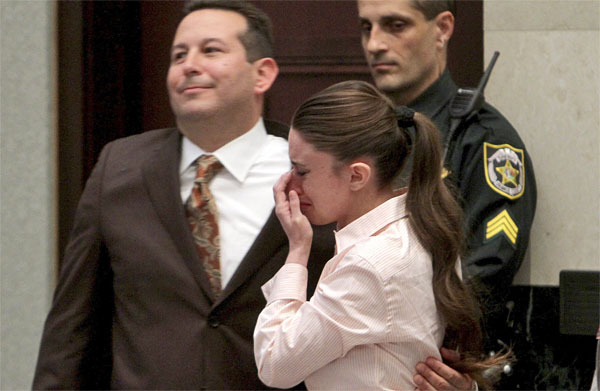
Photo: Reuters
Many comparisons have been drawn between the O.J. Simpson murder trial in the early 1990s and Casey Anthony's infanticide trial from this summer. 

Like the Simpson trial, the Anthony jury's verdict left most Americans scratching their heads, wondering about the state of the criminal justice system in America, and in their local community.  Unlike the Simpson case, however, the Orlando, FL trial was placed on the fast-track and, fortunately for everyone, the judge delivered.

In the Anthony case, the accused mother was acquitted of all murder charges, but convicted on four counts of lying to the police.  She has been incarcerated for about two years; she could get maxed-out on Thursday to 4-years (a year for each count), with credit for time served.  Her out date could be weeks, or even days away.

Tuning-in to the trial while grinding around town tending to my own clients, I was first struck by the possibility of an acquittal when the prosecutor's case in chief was taking two days to clear a so-called "expert" on foul odors; apparently captured in special containers for later sampling.  They had experts on top of experts.

The jury, filled with non-Orlando out-of-towners, made the prosecution pay.  When she earns a 7-figure income next year, Ms. Anthony will be sticking it in all our faces.

Meanwhile, in September, Michigan begins a probationary period for a series of innovative new court rules.  These rules, designed to encourage more detailed juror involvement and participation in a case, may have changed the Anthony verdict.  Click here for a detailed discussion of the specific changes.

One of the primary innovations is the ability of jurors to discuss the case among themselves and to ask their own questions of the witnesses, as the proofs are going in.  In a huge case like Casey Anthony, you have to wonder if the new rules would make a difference in the outcome if the case was to be tried here in Michigan.

If I had to guess, I would think most Casey Anthony jurors would attest to their frustration spending half the summer listening to a parade of junk scientists. Jurors have fine antennae for junk science.

In the end, all the junk scientists in the world could not overcome the fatal flaws in this case: lack of a cause of death; and the all-in gamble of a first degree murder theory.

Here is a great take on this trial by Harvard Law Professor Alan Dershowitz.

http://www.clarkstonlegal.com/

info@clarkstonlegal.com

Labels: , , , , ,

Saturday, July 2, 2011

New Court Rules Expand Jury's Role in Michigan Trials

This week, the Michigan Supreme Court integrated one of its pilot projects, involving the specific tasks of trial jurors, into the Michigan Rules of Court.  The significant changes take effect September 1st.

The MSC order, with only Justice Diane Hathaway dissenting, essentially revolutionizes the role of the jury.  Trial lawyers will note a sea change under the new rules. 

Some of us have already utilized these rules by conducting trials in Oakland Circuit Judge Potts' courtroom.

The new rules are significant in that, for the first time, standard jury instructions will be supplemented with legal theories of the issues, submitted to the court by the opposing lawyers, distilled by the judge, then supplied to the jury.  A trial judge thus retains all "editorial" powers relative to the theories and issues submitted by the lawyers, and consequently has great control over the content of each case as it goes in.  Under the old rules, in addition to a reading of a series of standard instructions, the parties requested various "special instructions" applicable to their specific case.

Here are the other significant changes:
  • In addition to the standard opening statement, parties may now request making an "interim commentary" as the evidence is going in.  This creates the possibility of editorializing the content of the evidence as it is entered into the record; the old rules limited all pre-evidence commentary to the opening statement. 
  • Also, a distinct possibility of in-trial interactive dialogue with a jury is possible given the new provisions allowing jurors to submit their own questions to witnesses.
  • Where appropriate, litigants will submit trial notebooks to jurors containing witness lists and relevant documents.
  • In civil cases, where depositions will be read into the record at trial, the parties must submit joint deposition summaries to the jury.
  • In cases utilizing expert testimony, one party's expert will be allowed to hear the testimony of the other party's expert, rather than sitting in the hallway of the courtroom under the usual sequestration order.
  • Perhaps most significant, jurors will be permitted to discuss the case amongst themselves during regularly scheduled breaks in the trial rather than waiting until formal deliberation when the proofs are completed.
In her dissent, Justice Hathaway commented that the rules allowing for interim jury questions, interim deliberations, and the submission of deposition summaries, will poison the trial process with unnecessary complications.

We here at the Law Blogger must admit that, with lawyers being, er, lawyers, the new rules do have fantastic potential to complicate the trial process.  On the other hand, the Wall Street Journal's Law Blog applauds these developments to the extent that they treat jurors as thinking adults; not a bunch of kindergartners.

http://www.clarkstonlegal.com/

info@clarkstonlegal.com

Labels: , , , , ,

Friday, October 8, 2010

Oakland Circuit Judge Potts Fosters Jury Innovation


Judge Wendy Potts has been conducting an interesting pilot program on the jury process in Oakland Circuit trials.  She maintains the only courtroom in one of Michigan’s busiest venues where jurors are encouraged to submit written questions to witnesses, take notes during the trial, and discuss the case during their morning and mid-afternoon breaks.

Once the jury is empanelled, each juror is provided a notebook with all the jury instructions and, in civil cases, a set of stipulated trial exhibits for their convenient reference (or distraction) throughout the trial. 

The jurors welcome the opportunity to interact with the input of proofs.  Judge Potts instructs jurors to avail themselves of the opportunity to submit written questions to each witness called to testify.   

These are significant modifications to the “classic” jury trial in Michigan.  In other county trial courts, jurors are expressly instructed not to discuss the case with anyone during the trial (which may take several days, even weeks).  In the classic jury trial model, jurors must keep the facts of the case to themselves until they retire to the jury room for deliberations with their chosen colleagues.  Nor are jurors usually given notebooks to write down their thoughts.

In Judge Potts’ court, however, jurors are encouraged to take a stab at figuring out just what is really going on by writing out their own questions at the conclusion of examination by the attorneys.  Judge Potts fields the written questions and discusses them with the lawyers in a bench conference to determine whether the question(s) should be posed to the witness.  

This has an obvious effect on how the proofs of the case are submitted to the jury.  Once the attorneys complete their scripted examinations, the jurors have the opportunity to follow-up.

Instead of keeping what they have just seen and heard to themselves for the duration of the trial, they are permitted to discuss the testimony, as it unfolds; including the answers to their own questions. 

No such a thing as a “dumb question”, right… 

On Thursday and Friday of this week, I had the opportunity to sample Judge Potts’ experimental jury trial method in a criminal felony case.  At least one juror had a question for every witness.  Judge Potts asked the attorneys at the bench whether we wanted the question posed to the witness.  

While I did not mind the (benign yet telling) questions posed by the jurors, it concerned me, as defense attorney, that the jurors were free to discuss the case while the proofs were going in.  

But would jurors, so encouraged, seek other means of obtaining information about the case?  Perhaps they would Google the names of witnesses or the attorneys.  Judge Potts expressly warned them not to do this.

It is in the nature of trial attorneys to want control of the information being submitted to the fact finder.  After all, ours is a results-oriented business.  

In the jury trial that concluded today, my client was acquitted.  It was difficult to tell weather the innovations had any effect on this outcome.

www.clarkstonlegal.com

info@clarkstonlegal.com

Labels: , , , ,