Blogs > The Law Blogger

The Law Blogger is a law-related blog that informs and discusses current matters of legal interest to readers of The Oakland Press and to consumers of legal services in the community. We hope readers will  find it entertaining but also informative. The Law Blogger does not, however, impart legal advice, as only attorneys are licensed to provide legal counsel.
For more information email: tflynn@clarkstonlegal.com

Saturday, October 6, 2018

Justice Kavanaughaustion

Unless we miss our guess over here at the Law Blogger, D.C. Circuit Court of Appeals Judge Brett Kavanaugh will be confirmed by the United States Senate later today. Kavanaugh will fill the SCOTUS seat vacated by Justice Anthony Kennedy.

Advice and Consent of the Senate

Article II, section 2 of the United States Constitution, where the rubber meets the road on the concept of balancing the branches of government, states:
[The President] shall have Power, by and with the Advice and Consent of the Senate ... [to] appoint ... Judges of the Supreme Court, and all other Officers of the United States, whose Appointments are not herein otherwise provided for, and which shall be established by Law...

America is Divided

It is impossible to avoid the crush of 24/7 news coverage of Judge Kavanaugh's nomination to the SCOTUS. America is now divided into two intractable camps: those that support Judge Kavanaugh and those that stand by his accuser, Dr. Christine Blasey Ford.

Judge Kavanaugh narrowly emerged from the Senate Judiciary Committee last week, irreparably damaged in the all-important court of public opinion. While the Judiciary Committee voted 11-10 to advance the nomination to the plenary Senate, a political compromise forced an expedited supplemental FBI investigation into Dr. Ford's allegations.

Ford claims that Kavanaugh, when they were at a high school party in the early 1980s, groped her; that he laid on top of her placing her in fear that he was going to rape her; and that he placed his hand over her mouth to prevent her from calling for help. [Criminal conduct on behalf of Kavanaugh, if true; criminal conduct on behalf of Dr. Ford, if untrue.] But for these 30-year old allegations, Kavanaugh, a conservative jurist, should have been a lock for Senate confirmation to the SCOTUS as the latest Trump appointee.

And of course, this being America, these allegations spawned other sets of allegations of more groping and excessive college drinking. All of the sudden, Judge Kavanaugh is no longer the conservative federal jurist from Yale Law School and the Georgetown Preparatory School [where SCOTUS Justice Neil Gorsuch also attended].

Although not a public document, the supplemental FBI investigation into Dr. Ford's allegations was supplied to Senators two days ago; the Senate vote is scheduled for later today. Apparently, in gleaning from statements by a few select Senators, the FBI report failed to corroborate any of Dr. Ford's specific allegations. We here at the Law Blogger would love to have been a fly on the wall when FBI agents interviewed Judge Kavanaugh's Jesuit prep-school wing-man, best-selling author, and general rabble-rouser Mark Judge. Alas, that's for another post.

With all this drama, you would think that the Federalist Society and the White House would have caught some wind of the strange brew wafting their way, and simply avoided all the burnt political capital by going to another conservative choice.

There is no question that Judge Kavanaugh, sitting on the D.C. Circuit through which momentous cases routinely flow, is a credentialed conservative jurist. The Washington Post, from an analysis of his published opinions over the past decade, concluded Kavanaugh was the most conservative jurist on the D.C. Circuit Court of Appeals in every policy area. [Note: consider the source; this is the same newspaper that initially reported Dr. Ford's letter to Senator Feinstein.] Nevertheless, his published decisions are along the lines of Justice Antonin Scalia; he is an originalist and a textualist, meaning that he does not find individual rights by reading "between the lines" of the Constitution. Like Scalia, he is far more conservative than moderate, and exhibits an expansive view of executive power.

This last bit is especially troubling during the Trump era. Listening to President Trump this week, grandstanding for Republicans on the eve of the mid-term elections, trying to minimize and dismiss Dr. Ford's allegations -comparing them to his own women troubles- was pathetic. If he could, Trump would do away with this "Advice and Consent" stuff altogether.  Trump was particularly un-Presidential when he mocked Dr. Blasey-Ford -her diction and her lack of memory on some details.

So here we are, with another Advise and Consent process that has torn the country apart. One thing is painfully clear: someone is lying.

There are no procedural rules for the Advise and Consent process. The Judiciary Committee is not a courtroom subject to rules of evidence and procedure. The nominee is not afforded the same constitutional rights as an individual accused of a crime. Likewise, an accuser does not need to prove allegations "beyond a reasonable doubt", the highest evidentiary standard.

Dr. Blasey Ford's Camp

Dr. Ford's allegations provide yet another high-profile example of the power, yet limitation, of the #metoo movement. Maddeningly for this camp, these allegations are so stale they are nearly impossible to corroborate. Thus, for this group, the allegations are destined to go down in history, like those of Anita Hill and Justice Clarence Thomas, as another unresolved allegation of "he said, she said" sexual assault.

Yesterday afternoon, Senator Susan Collins [R-Maine] focused on a lack of corroboration to an ancient allegation, signaling that she would be voting for Kavanaugh's confirmation. Under the threat of a felony charge [lying to a federal agent], apparently none of the individuals specifically mentioned by Dr. Ford, corroborated any of the basic details of her account to the FBI investigators.

Victims of sexual assault, for many different reasons, decide to suffer in silence for decades. Professionals in the criminal justice industry know that many survivors take their plights to their graves.

Criticism of the Ford supporters includes calling the detonation-event itself into question: the so-called leaking of Dr. Ford's letter to Senator Diane Feinstein to a ravenous media-machine that simply cannot get enough sexual raw meat. When the media took this ball and ran with it, Dr. Ford was the one that made the down payment up front. Some say she was betrayed by the very people she turned to as a #metoo survivor. For her part, Senator Collins does not believe that her colleague from California disseminated the original letter to the press. These and other Senators are now all running for political cover.

Judge Kavanaugh's Camp

The Judge's supporters are glad that Senator Collins saw things their way and did not find Dr. Ford's allegations persuasive by even a preponderance of the evidence in the Senate record. Certainly not persuasive enough to block Kavanaugh's nomination. Also, the judge's camp is quick to point out that this has become a derailed media circus -which is true- focusing on sex, beer and UB40, rather than the judge's 12-year record from the federal bench.

These supporters emphasize that Judge Kavanaugh has already undergone half a dozen FBI investigations during his storied career as a federal judge. This conservative group is looking forward to possibly 4-decades of right-leaning opinions from this truly conservative jurist, especially when paired with Justice Gorsich, his Jesuit-trained prep school classmate. The Federalist Society recognized that Kavanaugh, unlike his Reagan-appointee predecessor, Justice Anthony Kennedy, who became the infamous "swing vote" on the SCOTUS, will remain true to his conservative faith.

If the right cases come along, you can expect this jurist to increase the powers of the executive branch, and limit individual rights in favor of the powers of the state. In a perfect storm, a case involving abortion may get teed-up for his deciding vote; he may even be assigned by Chief Justice John Roberts to write the historic opinion.

Like Dr. Ford, however, Judge Kavanaugh is not getting out of this process unscathed. His otherwise stellar career as a conservative federal jurist now bears this horrid permanent stain.

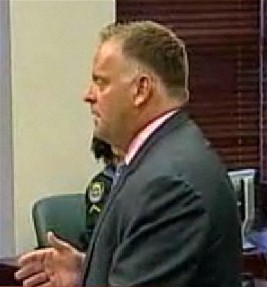
As with the Federalist Society, we do not think this episode will affect the tone or tenor of now-Justice Kavanaugh's prospective SCOTUS opinions, yet plenty of questions remain in our minds about this jurist; this person. Despite his apology in the Wall Street Journal, we saw his core-temperment in the heat of battle when he testified; it was not pretty; it was ugly. The picture above truly, is worth a thousand words. Where unproven allegations of sexual abuse are concerned, the smoke usually manifests some type of fire.

While the fire in Kavanaugh's case was extinguished long ago, you won't be seeing this SCOTUS justice giving speeches or lectures at Harvard Law School. He will be hunted and confronted in public until the day he dies.

We shall see if he, like Clarence Thomas, sits silent during oral argument, never asking questions of the lawyers arguing their cases before him; preferring to communicate through written opinions. In any event, a decades-long tenure will be Kavanaugh's best revenge. His place in history, however, already has been set in stone.

America Gets Screwed

Because one of these two people is lying, America gets screwed. If Dr. Ford told the truth, this guy's transgressions, albeit over 30-years ago, belie a violent and abusive core, inappropriate -even disqualifying- for any judge, let alone a Supreme Court Justice. If Judge Kavanaugh told the truth to the Judiciary Committee, then a special place in Hell awaits women that manufacture and weaponize false allegations of sexual abuse. Take your pick; it's all bad folks.

Our take-away from all this drama is that public respect and trust in our all-important judicial system is eroded by spectacles like this one. The lawyers at our firm are constantly advancing the legitimate causes of our clients before county and state judges. We depend on these judges to fairly resolve important legal conflicts.

In times like these, we thank our colleagues on the bench that have remained ever-vigilant for the right result in every case, and who have remained just and impartial despite the strong, often pungent, political currents of the day.

www.clarkstonlegal.com
Post #620


Labels: , , , , , , , ,

Tuesday, November 15, 2016

Pair of Michigan Justices on Trump's SCOTUS Short List

Ever demure, Michigan Supreme Court Chief Justice, Robert Young, Jr., the highest elected African-American in our state government, stated he was unaware of his inclusion on a short-list for President-Elect Donald Trump's consideration to replace former Justice Antonin Scalia at the SCOTUS.

Justice Young, along with fellow Michigan Supreme Court Justice Joan Larsen, were included in Trump's May and September announcements regarding potential SCOTUS appointments. Both Michigan Justices are members of our High Court's conservative block.

Over the years, this blogger has had several occasions to interact with Justice Young. Most recently, when I argued a 4th Amendment search and seizure case at the Michigan Supreme Court last December, it was Justice Young that did most of the questioning. Back in 2008, I shared a panel with Justice Young on the topic of one of my felony-murder appeals that also made it to the Supreme Court.

As part of the Michigan High Court's conservative block, the justices are among those who take a textualist approach to both the Michigan and the United States Constitutions. This means that they decide cases in accord with the precise meaning of the text of the constitutions and the statutes impacting the case, rather than in accord with their own personally held political beliefs.

Deceased Justice Scalia was the textualist-in-chief; he deplored the judical activism which has been a hallmark of the liberal block on the SCOTUS. One of Trump's avowed first orders of business will be to fill the vacancy on the Court to restore the 5-4 majority that has held sway over most of the past decade.

In our opinion, Justice Young would be a well-qualified appointment; an appointment, however, that seems unlikely amid the clamor in the nation to appoint an ultra-conservative federal jurist to the SCOTUS.

Post #566

www.clarkstonlegal.com
info@clarkstonlegal.com


Labels: , , , ,

Friday, April 1, 2016

Justice Thomas Speaks-Up During Gun Argument

As appellate lawyers, we here at the Law Blogger appreciate the importance of solid cogent and logical oral argument. Oral arguments are the opportunity for the lawyers, after filing briefs, to explain their case to the panel of judges.

As SCOTUS watchers, we have noted that conservative Justice Clarence Thomas, since his appointment by George H. W. Bush in 1991, has rarely posed questions to the lawyers during argument. His decade-long stretch of silence was broken during oral argument last month on a Second Amendment case.

Not only did Justice Thomas break his silence, he posed a series of questions to the lawyers on a case that posed the question whether a misdemeanor domestic violence conviction should bar someone from the possession of a firearm for the rest of their life.  The last time Justice Thomas posed a question from the bench, it was February 2006 in a death penalty argument.

Justice Thomas has stated his reasons for not pipping-up from the bench. He believes many lines of questioning during oral argument are inappropriate; adding nothing to the substantive issues of the case and being more about a judge showcasing his or her own jurisprudential world view.

One high-profile justice, a good friend of Justice Thomas with a seat adjacent to his on the SCOTUS bench, the recently-departed Justice Antonin Scalia, reveled in questioning the lawyers during oral arguments. As a fellow conservative jurist, Scalia was the extrovert to Thomas' introvert.

Here in Michigan, many appellate practitioners are vocal about doing away with the oral argument tradition. The primary thrust of the argument is that it really does not add much to the decision-making process while consuming a disproportionate level of judicial and attorney resources.

The counterpoint is that oral argument presents the only opportunity for the judges deciding a case to question the lawyers about their reasoning and legal analysis; to better inform the judges about the case they are going to decide.

Having Justice Thomas ask a question is so rare, the event received front-page treatment on the NYT. His questions also spawned legal commentary about the efficacy of oral arguments in general; here is the link to the SCOTUSBlog post on the subject.

Post #533

www.clarkstonlegal.com
info@clarkstonlegal.com


Labels: , , ,

Tuesday, February 16, 2016

Justice Scalia's Constitutional Legacy

The stunning news swept the country over the weekend; the longest-serving SCOTUS justice on the current bench, Antonin Scalia, died suddenly in Texas at age 79. His death leaves a vacancy on the bench of the High Court that is sure to create political tensions in this, a highly contentious election year.

Justice Scalia was appointed to the Supreme Court by President Ronald Reagan in 1986 and was unanimously confirmed by a U.S. Senate vote of 98-0. Whoever is nominated by President Obama will not have it so easy with Republican members of the Senate vowing to block any appointment until after the election.

A conservative justice, Scalia disdained consideration of legislative commentary about the meaning and purpose of a particular law. He focused instead on the original intent and meaning of the U.S. Constitution, as ratified by its drafters; the so-called Founding Fathers.

An unusual paradox of Scalia's constitutional originalist philosophy was its effect on matters involving criminal defendants. Justice Scalia was consistent in his judicial philosophy, studying each case before the SCOTUS, with great regard for the text of the specific clause or amendment at issue.

In the cases of the Sixth Amendment confrontation clause and the Fifth Amendment right to a fair trial at the sentencing phase, citizens accused of serious crimes benefited from Scalia's originalist approach.

We here at the Law Blogger took advantage, for example, of Scalia's majority opinion in Crawford v Washington, a Sixth Amendment confrontation clause case, when the Washtenaw County Prosecutor convicted one of our clients based, in part, on a DNA analysis that featured testimony from only one of the 3 lab technicians that prepared the report. Scalia's majority opinion was very useful in the ultimate habeas corpus petition filed in the United States District Court for the Eastern District of Michigan.

Another example of Scalia's handiwork in the realm of the constitutional rights of the accused is his dissent in the 2000 case of Apprendi v New Jersey, which ripened into a majority opinion 4-years later in Blakely v Washington, holding that a judge cannot fashion a sentence based on facts that were not proved beyond a reasonable doubt by evidence submitted at a trial. This decision played a part in scraping the federal sentencing guidelines and, more recently, the Michigan sentencing guidelines. Now, facts that give rise to a punishment are either assented to by the convicted defendant, or determined by a jury beyond a reasonable doubt; they can no-longer spring from the pages of a probation intake officer's report.

Neither Scalia's Sixth Amendment confrontation clause opinions, nor his Fifth Amendment sentencing decisions are pro-conservative. Yet, they are consistent with his originalist theory of constitutional law; and they are necessary for a truly free society.

So now what? President Obama has vowed to do his duty as President and make an appointment to fill the vacancy under Article II, section 2 of the U.S. Constitution. The Constitution also provides, however, for such an appointment to receive confirmation by the Senate.

This is an election year and at least one of Justice Scalia's former law clerks, Ted Cruz, is running for the Republican nomination for President. Senator Cruz has remarked about an informal unwritten convention in American politics that a sitting but "lame duck" President does not get to have his SCOTUS nomination confirmed.

In the 20th Century alone, there were six justices appointed and confirmed during a sitting president's last year in office before an election: Justice Anthony Kennedy in 1986; Michigan's Justice Frank Murphy in 1940; Justice Benjamin Cardozo in 1932; Justices Louis Brandeis and John Clarke both in 1916; and Justice Mahlon Pitney in 1911. Therefore, we here at the Law Blogger have to wonder what Senator Cruz is talking about.

Post #524

www.clarkstonlegal.com
info@clarkstonlegal.com


Labels: , , , , ,

Saturday, December 5, 2015

Marriage Equality: Justice Scalia vs Judge Posner

Since 2009, this law blog has tracked marriage equality and its attendant same-sex civil rights movement. This movement swept the nation, culminating in a pair of SCOTUS opinions -Obergefell [2015] and Windsor [2013].

As he has done in several past dissents, Justice Scalia puts forth a vehement opposition to same-sex marriage in Obergefell, and since writing his dissent in that case, has spoken formally, openly, and often. His message: there is no textual or historical basis for the majority's ruling that laws and government policies must be gender neutral.

Justice Scalia believes that the thread of same-sex marriage decisions is the most glaring example to date of the SCOTUS doing "whatever it wants". He seems most troubled by the fact that the marital equality decisions are contrary to the religious beliefs of a significant portion of the citizenry. Such decisions are for the elected legislators -not for an un-elected committee of lawyers wearing robes- according to Scalia.

In his recent public comments on the landmark SCOTUS decision, Scalia has radicalized himself, even among conservative legal scholars. Speaking before law students at Georgetown, he equated, perhaps sarcastically, child molesters to homosexuals. To be precise, Scalia said there is no principled basis on which to distinguish the two "minority" groups. The implication is that, like "homosexuals", child molesters will be the next group to seek protected status under the constitution.

Judge Richard Posner of the Seventh Circuit Court of Appeals in Chicago, one of the most cited jurists of the 20th Century, -and like Justice Scalia, a legal conservative- takes Scalia to task for his comments in a well-read NYT editorial. In the piece, Posner seems most concerned about Scalia's declaration that post-Obergefell, American democracy is dead.

Judge Posner is also troubled by Scalia's assertion that 9 un-elected lawyers, cloaked in robes, should not be the brain-trust behind such important matters as marital equality or any civil rights struggle for that matter. Judge Posner also uses Scalia's own logic against him, pointing out that Scalia does not hesitate to vote for invalidating state laws or legislation that contravene the First Amendment, or some of his pet federalism-related clauses of the U.S. Constitution.

Finally, Judge Posner takes Scalia's public commentary to its logical conclusion: the abandonment of proper judical review. Posner has a good point here; one of the primary roles of the SCOTUS, at least since the 1803 Marbury v Madison decision, is to conduct rigorous judicial review of the myriad pieces of legislation that the many many legislatures and legislators dream-up.

Over time, legislators of every stripe imaginable are elected into the legislatures of our country; some of whom have been bit with a special kind of fever. We here at the Law Blogger sleep better at night knowing that their work-product must withstand judicial review relative to the U.S. Constitution.

www.clarkstonlegal.com
info@clarkstonlegal.com

Post #510

Labels: , , , , , ,

Friday, June 19, 2015

Religious Rights Gain Ground in the Workplace

Victorious Samantha Elauf
The SCOTUS issued another opinion, this time from Justice Antonin Scalia, strengthening religious rights in the workplace. In EEOC v Abercrombie & Fitch, the High Court reversed a 10th Circuit Court of Appeals' ruling that favored an employer's right to uphold a corporate dress code; in this case, it was Abercrombie's "no head wear" policy.

The case involves the intersection of fashion, commerce and the freedom of religious expression under the First Amendment. Samantha Elauf, a Muslim teenager back in 2008, applied to an A&F store in Tulsa, Oklahoma.  Although she fared well in her interview, she was not hired because of the store's no head-wear dress code.

The offending garment was the applicant's hijab. A&F fosters the "Ivy League preppie look" thus, there is no room for a hijab, caps, scarfs, or head wear of any kind.  At the SCOTUS, Abercrombie argued that no religious discrimination occurred because it had no "actual knowledge" that Ms. Elauf wore her hijab for religious reasons; she was silent on the subject during her interview.

The EEOC, along with the Council on American-Islamic Relations, took up Elauf's case and won a jury verdict of $20,000 in damages for Ms. Elauf.  A&F successfully appealed to the 10th Circuit Court of Appeals, which reversed the jury verdict, persuaded as it was by A&F's argument that the applicant did not specifically request special religious accommodation for her hijab.

Justice Scalia's decision was aptly summarized in Amy Howe's "Plain English" post for SCOTUSBlog:
The Court reasoned that the federal law at issue in this case, Title VII of the Civil Rights Act of 1964, bars employers from refusing to hire someone “because of” her religion, which includes religious observances. And in the context of this law, the Court continued, the phrase “because of” requires only that “an individual’s actual religious practice . . . not be a motivating factor” behind the failure to hire her. There is no requirement that the employer actually know that there could be “a conflict between an applicant’s religious practice and a work rule.” Indeed, the Court emphasizes, although other antidiscrimination statutes do explicitly require knowledge, Title VII does not. Therefore, reading the statute to include a knowledge requirement would “ask us to add words to the law to produce what is thought to be a desirable result.” And that, the Court made clear, “is Congress’s province.” 
Similarly, Abercrombie's argument-in-the-alternative that its dress code applied to all employees was rejected by the SCOTUS.  The Court's ruling states that the civil rights act does not require employers to be neutral but rather, that they provide an applicant's or employee's religious practices "favored treatment."

In the workplace, this means that employment practices that are otherwise neutral must now "give way to a need for an accommodation."  Business groups have already taken issue with the ruling on the basis that it puts employers behind the eight ball with a confusing standard that forces the employer to guess at an applicant's religious practices.  Also, business groups fear the opinion opens the door to litigation, making employers vulnerable within the context of the "favored treatment" workplace.

We here at the Law Blogger wonder which religious practices are going to surface in the inevitable cases spawned by this decision. No doubt, there will be some interesting ones, you just wait and see...

www.clarkstonlegal.com
info@clarkstonlegal.com


Labels: , , , , ,

Tuesday, November 18, 2014

SCOTUS Considers Review of Michigan Same-Sex Marriage Case

Last June, I was preparing for oral argument in a wrongful death case before a panel of the United States Sixth Circuit Court of Appeals in Cincinnati, Ohio.  In that file preparation, we learned that one of the judges on our panel, Jeffrey S. Sutton, a George Bush appointee, was the former law clerk to SCOTUS Justice Antonin Scalia; it does not get more conservative than that.

Judge Sutton was the presiding judge in the DeBoer case and authored the 64-page, 2-1 appellate opinion; his analysis was consistent with his conservative judicial philosophy.  As is now widely known and reported, the Sixth Circuit reversed U.S. District Judge Bernard Friedman's opinion and order from last year invalidating Michigan's ban on same-sex marriage and adoption on constitutional grounds.

As is often the case in federal appeals, the DeBoer case was combined with several others, from other states in the 6th Circuit: Ohio, Kentucky and Tennessee.  The portion of the caption in this case, listing the myriad attorneys glomming onto the file, goes on for 3 and 1/2 pages; it's getting ridiculous.

We predicted that attorneys in the DeBoer case and its companion cases would act quickly and yesterday, petitions were filed for certiorari in the case with the United States Supreme Court.  We here at this blog were pleased to see one of our guest bloggers, Wayne State Law Professor Robert Sedler, to be listed among the corps of esteemed legal counsel of record in the case.

The sole and simple issue raised on appeal is whether state denial of the same-sex right to marry [and adopt children] comports with our federal constitution.  In the petition, DeBoer asserts that hers is the ideal case because:
  • there was a 9-day trial with a fully-developed record [actually, it was more like a battle-of-the-experts, as so many high-profile case are these days]; 
  • unlike other states where the state attorney general declined further challenge after losing in federal court, or at the intermediate appellate stage, the Michigan Attorney General has vowed to carry on the fight to the SCOTUS; and 
  • the Sixth is the first federal circuit to uphold a state law ban on same-sex marriage giving rise to a conflict among the federal circuits for the first time; something that SCOTUS looks for when assessing the hundreds of petitions for certiorari.
Assuming the SCOTUS is of a mindset to address this civil rights issue with this round of cases, and assuming that the various state actors submit their filings by mid-January, the DeBoer case could well be argued this term.

Oral arguments at some point in April will leave the High Court in a position to issue a decision in the case by the end of the term in June.

www.clarkstonlegal.com
info@clarkstonlegal.com


Labels: , , , ,

Friday, May 30, 2014

Are SCOTUS Justices Techno-Luddites?

By:  Timothy P. Flynn

Paul Fletcher, the publisher of Michigan Lawyers Weekly, suggested that Justice Antonin Scalia should rent episodes of the HBO mega-hits, "Game of Thrones" and "Boardwalk Empire".  The purpose of this: to educate Justice Scalia about HBO [referenced in a recent case]; he seemed to misunderstand the pay-to-view business model of the network; he has probably never had cause to purchase the service.

Last year, Chief Justice John Roberts famously inquired about the difference between an e-mail and a pager. Imagine that disconnect.  Remember pagers...?  And imagine life without e-mail or cell phone; there's an upside to that world view.

Then there's Justice Anthony Kennedy who assessed that mission-critical high-end software coding could be accomplished by "any group of computer people sitting around a coffee shop", over a weekend, munching on code; magically producing software by Monday morning, in a commerce-ready format no less.  Also very disconnected.

According to Fletcher, Justice Sonia Sotomayor, despite her minor "netflick - netflix" gaffe during some recent oral arguments, gets the highest marks for being techno savvy.  Her colleagues, on the other hand, were described as "incompetent Luddites" by an unidentified legal blogger that spoke with the Reuters news service.  We here at the Law Blogger agree with Fletcher that such an assessment is overly harsh; probably wasn't anyone from over at SCOTUSBlog.

A simple solution is to have the SCOTUS law clerk corps train the Justices about the basics of wired e-law with a few clutch, but rudimentary devices.  Such things are traditionally delegated in the marble fortress housing the SCOTUS chambers.

At some point, however, reality does finally come crashing in.  Historically, SCOTUS lags behind, relative to the other branches of our government, from a technological perspective where, repeatedly, it receives poor marks.  

www.clarkstonlegal.com
tflynn@clarkstonlegal.com


Labels: , , , , , , , ,

Friday, July 22, 2011

Casey Anthony's Lawyers Are Breaking Bad

San Diego Attorney
Todd Macaluso
I recall putting on my shirt and tie for court while watching GMA two years ago and seeing one of my law school acquaintances, Todd Macaluso, being interviewed as the newest member of Casey Anthony's so-called "dream team" of defense lawyers.  The interview in Florida was surprising to me, as I thought Todd was a product liability lawyer in California.  Hey, headlines are headlines, right.

Todd comes from a wealthy family out east and he married well; very well.  Not interested in Harvard, NYU, or any of the tony east coast law schools, Todd collected his sheepskin right here in the "D" from the University of Detroit School of Law; class of 1987.

Before his graduation ceremony was even concluded, Macaluso was probably on a private jet to San Diego, where he hung his shingle and hasn't looked back.  And apparently he has not stopped playing around with private aircraft either, from the way the headlines read this week.

Although forced to quit the Casey Anthony case due to a serious attorney discipline conviction and imminent disbarment in California, Todd is right back in the cockpit, just in time to seize the spotlight, allegedly ferrying Ms. Anthony about the country on his private Pilatus PC-12 turbo-prop aircraft.

The national media, led by Nancy Grace, is in an absolute frenzy over Anthony's location.  Knowing Todd, he is loving every minute that he is able to steal the show by flying the infamous "Tot Mom" hither and yon.  Hopefully, his 15-minutes will expire by month's end.

Macaluso is a poster child for the adage: "image is everything".  He is acknowledged, among dozens of others, in United States Supreme Court Justice Antonin Scalia's book, Making Your Case.  A mutual friend who's been to Macaluso's home says there is a photo of Todd on his yacht with Justice Scalia, apparently a friend of the extended Macaluso family.

In 2007, Macaluso received the President's Award from the UDM School of Law.  In presenting this award, UDM acknowledged Todd's lobby efforts in Congress to regulate pharmaceutical sales over the Internet. Nothing was mentioned, however, about the opportunistic nature of his burgeoning criminal defense practice.

With the benefit of hindsight, I just have to wonder if my alma mater would have bestowed its President's Award on a graduate who soon would be disbarred for misspending client trust funds; or whether Justice Scalia would acknowledge an attorney that has not only joined forces with a most infamous client, but has positively delighted in concealing her location, while she prepares with her lawyers to fleece all of us.

Only in America folks; only in America.

http://www.clarkstonlegal.com/

info@clarkstonlegal.com

Labels: , , , , , , ,

Monday, May 30, 2011

SCOTUS Orders the Release of More than 45k California Felons

Photo Credit: LA Times
In a hotly contested 5-4 plurality decision that will surely go down as one of the more controversial cases of this decade, SCOTUS affirmed the 9th Circuit Court of Appeals in ordering the release of more than 45,000 California felons.  The decision will precipitate the largest release of prisoners in American history.

Brown v Plata began it's marathon crawl through the federal court system in 1990, when a case was filed challenging the poor status of mental health treatment in the California prisons.  Then in 2001, a companion case challenging the medical care of prisoners was initiated.

These consolidated cases have everything, from a procedural standpoint.  For example, a "special master" first was appointed by the federal court to make findings about the prison conditions.  The State of California stipulated to violations of the Eighth Amendment's prohibition of cruel and unusual punishment and agreed to remedy the problem by reducing overcrowding in the prisons.  Next, when remedial measures fell short, or did not occur, the court appointed a receiver to oversee the California Department of Corrections.

The cases were even assigned to a special three-judge panel to oversee the CDC's progress; or lack thereof.

Justice Anthony Kennedy wrote the majority's opinion, finding that prison conditions had gone too far for too long.  The opinion provides a few slices of life in the CDC like sharing a toilet with 55 of your good buddies, or doing your entire four-year bit in a sweaty gymnasium. 

The always-conservative Justice Antonin Scalia opined that the majority's decision was "absurd", noting that SCOTUS routinely overruled 9th Circuit decisions that called for the release of individual prisoners.  Justice Scalia sees grave problems that will come home to roost from the Plata ruling.

In a separate dissent, Chief Justice John Roberts wrote that the majority's decision conflicts with a federal law which prohibits judges from releasing prisoners.

The one thing SCOTUS gave the State of California was time.  California has busied itself with transferring thousands of state prisoners to county jails across the state.  This will not amelioriate the entire problem, however, and some of California's "happy-go-lucky" [Scalia's characterization] felons will wind up on the streets.

This High Court decision brings into focus the inherent tension between our individual freedoms and enforcement of the laws.  There is a constant tension between the two concepts.  Sometimes, that tension cycles to the breaking point like in California, where too many law breakers are stuffed into concrete boxes that are ready to explode.

In Michigan, although we are far behind California in maxing-out our prison capacity, we have an awful lot of population encased in concrete and barbed wire.  In fact, we have the opposite problem.  Due to budget cuts, we have at least one brand new facility, in Lake County, sitting empty due to lack of funding.

http://www.clarkstonlegal.com/

info@clarkstonlegal.com

Labels: , , , , , , , , ,

Saturday, March 12, 2011

The Right to be a Millionaire

The NFL team owners, a tony group, just announced an official lock-out of their players.  For their part, the players have dissolved their union and several super-stars have filed a high profile class action law suit against the owners.

Football is America's most popular sport and has grown into a billion dollar industry over the past decade.  With the lock-out and the law suit, however, looks like the 2011 season is in jeopardy.

The super-star quarterbacks' lawsuit, formally known as Brady vs NFL, was filed in the U.S. District Court in Minneapolis, MN and asserts an antitrust claim against the storied league while seeking an injunction to terminate the lockout.

The quarterbacks are represented in Minneapolis by the Berens Miller law firm.  The league is in the good hands of Attorney Aaron Van Ort, a former law clerk to both SCOTUS Justice Antonin Scalia and well-known 7th Circuit Judge Richard Posner.

Another Justice Scalia connection:  The players' case, initially assigned to U.S. District Judge Richard Kyle who promptly recused himself, was re-assigned to Judge Patrick Schiltz, also a former Scalia law clerk.

For their part, the owners, on average only slightly wealthier than the league's star players, are claiming poverty in the complexity of operating a modern football franchise. 

While millions of NFL fans wait to see whether there will be a season, and drafted rookies wait to see whether they will become newly minted millionaires, the attorneys in the case will be walking away with millions in legal fees.

Now go count your money.

http://www.clarkstonlegal.com/

info@clarkstonlegal.com

Labels: , , , , , ,

Thursday, March 10, 2011

SCOTUS Erodes Witness Confrontation Requirement

This case was straight out of Detroit.  Anthony Covington was lying next to his car at a gas station, shot in the stomach, bleeding out, but still alive and speaking with the Detroit Police.

Just before he died, he identified Rick Bryant as his shooter.  Bryant's subsequent conviction, based largely on the dying man's identification, went all the way to the SCOTUS and was decided last month.

Conviction affirmed; and in the process, one of the many exceptions to the hearsay rule is broadly expanded at the expense of accused persons everywhere.

The 6-2 decision in Michigan v Bryant erodes the confrontation clause of the Sixth Amendment requiring that all witnesses against an accused be brought to court.  Surprisingly, Justice Sotomayor wrote for the majority; Justice Giinsburg recused herself; and just as surprisingly, Justice Scalia wrote in dissent.

This case is significant to the extent that it allows police officers to testify at a trial about what an out-of-court (i.e. hearsay) witness said when that witness is no longer available for purposes of cross-examination and in-court confrontation.  Whether a dying man's declaration comes into evidence at a criminal trial depends on the "testimonial" nature of his utterance.

Prior SCOTUS decisions have addressed this problem.  Until now, two domestic violence cases established each end of the continuum.

In the well-known case of Davis v Washington, the declarant's statment -made during a 911 call- was admitted because the emergency was ongoing when the statement was made.  The presence of the emergency made the statement non-testimonial and thus, admissible in court even though the declarant was not present at the trial.

On the other hand, when a statement is made after the emergency is extinguished, as in Hammond v Indiana, then such a statement is clearly testimonial; that witness must be brought into court, or the statement is excluded from trial.  The witness in Hammond made her statement from the safety of her home during a subsequent police visit. 

The Bryant Court constructs a complicated two-perspective test to determine the "testimonial" nature of a dying man's declaration.  A reviewing court must now consider both the declarant's primary purpose in uttering the statement, along with the recipient's purpose in receiving the statement.  Say what??

Writing for the dissent, Justice Scalia, not usually a champion for the defense but an ardent supporter of the confrontation clause, thinks the question "is an absurdly easy one".  The murder victim from Detroit, in his last breath, was telling the Detroit Police who shot him so they could apprehend the shooter; not to stop any "emergency".  Therefore, the statement was testimonial in nature and should not be admissible in court according to Scalia's analysis.

Seems like each year SCOTUS issues at least one decision from Detroit and the surrounding area that has a local murder at issue.  Last year it was Warden Berguhis v Thompkins; this year it's Rick Bryant's case.

Kinda sad that we're known for the laws that get spawned from these murders.

http://www.clarkstonlegal.com/

info@clarkstonlegal.com

Labels: , , , , , , , , , ,